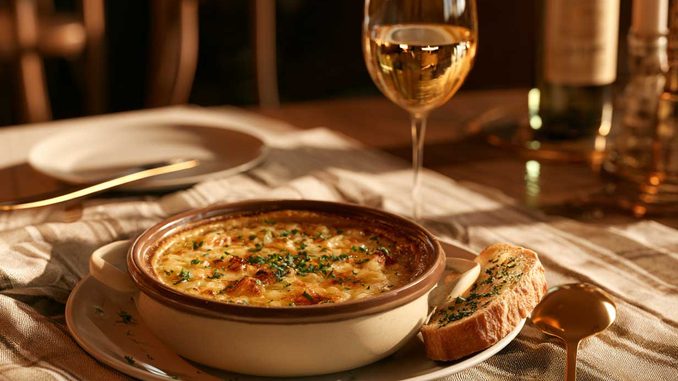
From the market stalls of Paris to Lyon’s bouchons, discover the history of French onion soup, its regional variations and the secrets of a perfect gratinée.
French onion soup, or soupe à l’oignon, is one of France’s most recognisable winter dishes. Its defining ingredients are slowly browned onions, savoury broth, toasted bread and a gratinated cheese topping. Yet the familiar Parisian version is only one chapter in a much older story. Medieval French cooks prepared onion soups centuries before the bustling restaurants around Les Halles made gratinée famous in the nineteenth century. Lyon has its own traditions, including versions enriched with Madeira, port or egg yolk. In Alsace, smoked pork sometimes gives the soup a different character. Making it well requires a generous quantity of onions, a heavy pan and enough time for moisture to evaporate and flavour to develop. For four servings, allow roughly an hour to cook the onions before simmering the broth and grilling the cheese. The result is economical, filling and particularly well suited to winter, when storage onions are abundant.
The French classic that turns onions into a winter meal
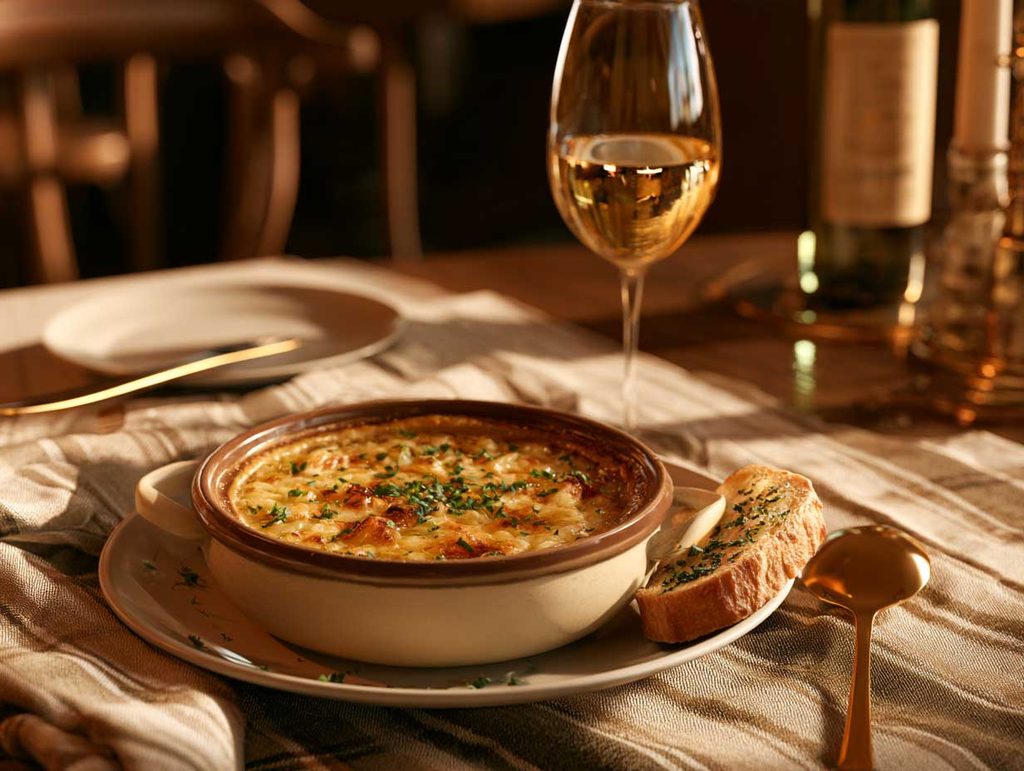
The first thing a spoon meets is the crust: golden cheese gripping a thick slice of bread. Underneath lies a dark, aromatic broth filled with softened onions. This is French onion soup, or soupe à l’oignon gratinée, at its best.
It is not simply vegetable broth with sliced onions floating in it. The onions should remain recognisable, silky rather than puréed, while the liquid is savoury enough to balance their sweetness.
The ingredients are modest. The cooking is not.
Onions contain water, natural sugars and aromatic compounds that change dramatically with prolonged heat. As moisture evaporates, browning reactions develop toasted, nutty flavours. Rush this stage and the soup tastes sharp. Burn the onions and bitterness dominates.
A successful bowl depends more on patience than expensive ingredients.
The history of French onion soup, from medieval kitchens to Les Halles
Onion soup existed long before the modern Parisian bistro. A fourteenth-century recipe in Le Viandier, associated with Taillevent, describes onions cooked in butter and combined with liquid, pea purée and verjus, the acidic juice of unripe grapes.
The familiar story that Louis XV invented onion soup using butter, onions and champagne in a hunting lodge is a legend, not an established historical fact.
Its defining urban chapter came in nineteenth-century Paris. Around Les Halles, the capital’s wholesale food market, soup sellers fed porters, traders and butchers beginning work before dawn.
Nearby restaurants popularised the gratinée des Halles, topped with bread and cheese and browned under intense heat. The clientele eventually included revellers finishing their night alongside labourers beginning theirs.
When the wholesale market moved to Rungis in 1969, the soup remained part of Parisian culinary identity.
The regional variations that give French onion soup different characters
Like many dishes shaped by French regional cooking, onion soup has no single definitive recipe.
The Parisian tradition of bread and melted cheese
Parisian gratinée usually arrives in an ovenproof bowl beneath a bubbling layer of Gruyère, Comté or Emmental.
Gérard de Nerval mentioned onion soup served at Les Halles with Parmesan in 1852, demonstrating that cheese choices were never entirely fixed.
The broth may contain beef stock, poultry stock or simply water. What matters is the contrast between concentrated onions, soaked bread and a deeply browned surface.
The Lyonnais tradition of richer finishing
Lyon also claims onion soup as a regional speciality.
Older soupe lyonnaise à l’oignon recipes sometimes use rendered pork fat and poultry broth. One documented regional preparation incorporates round-grain rice.
Restaurant interpretations can be richer. At Lyon’s Brasserie Georges, a gratinée au madère was already listed on the menu in 1949. The finishing ritual involves incorporating Madeira and egg yolk beneath the cheese crust.
The result is rounder and more substantial than a simple broth-based soup. Neither Lyon nor Paris can reasonably claim exclusive ownership of the dish.
The Alsatian interpretation with smoked pork
Some Alsatian recipes incorporate smoked bacon, giving the onions a salty, smoky counterpoint.
Poultry stock and Gruyère are also common in these interpretations. Others feature wine or regional spices.
These are local adaptations rather than a universal Alsatian standard. They demonstrate how a simple recipe can absorb regional ingredients without losing its essential character.
The method for making authentic French onion soup at home
The ingredients for four generous servings
A reliable French onion soup recipe requires 800 g yellow onions, 60 g unsalted butter, 1.2 litres of beef or vegetable stock, 150 ml dry white wine, four thick slices of day-old baguette, 140 g grated Gruyère or Comté, one bay leaf, two thyme sprigs, salt and black pepper.
These proportions produce a substantial soup without allowing the stock to overwhelm the onions.
The slow cooking that creates the flavour
Peel, halve and slice the onions evenly, approximately 3 mm thick.
Melt the butter in a wide, heavy-bottomed pan. Add the onions and a little salt. Cook over medium-low heat for 40–55 minutes, stirring more frequently as they darken.
The aim is a soft, deep amber mass, not crisp brown edges. If the pan begins to catch, loosen the browned deposits with a splash of water.
Add the white wine and scrape the bottom of the pan. Reduce for two to three minutes before adding the stock and herbs.
Simmer uncovered for another 20 minutes. Taste before adding salt because the stock and cheese may already provide sufficient seasoning.
A little flour can thicken the broth, but it is not essential.
The cheese crust that defines the gratinée
Toast the baguette until firm enough to resist immediate collapse. The structure of traditional French baguette bread makes it particularly suitable for this preparation.
Divide the soup between four ovenproof bowls. Place the toasted bread on the surface and cover with grated cheese.
Set the bowls on a baking tray and grill at approximately 220°C (425°F) for five to eight minutes, until the topping is golden and bubbling.
Allow the bowls to stand briefly before serving. Both the cheese and broth retain intense heat.
The reasons French onion soup is particularly good in winter
Winter suits this dish for practical reasons beyond nostalgia.
Cured yellow onions are storage vegetables. Under appropriate conditions, approximately 10°C and 60–70% relative humidity, they can remain usable for three to five months, according to the University of Saskatchewan.
Bread that has become too dry for sandwiches gains another purpose beneath the grill. The soup also lends itself to advance preparation: cook the onions and broth earlier, then reheat and gratinate immediately before serving.
Unlike the South West’s traditional French cassoulet, much of its substance comes from bread and cheese rather than meat.
There is no need for cream, elaborate garnishes or an expensive cut of beef. A good vegetable stock can produce an excellent meat-free version.
French onion soup deserves its reputation not because it is difficult or luxurious, but because it rewards restraint. A handful of inexpensive ingredients, handled with care, can develop an intensity that more complicated winter dishes struggle to match.