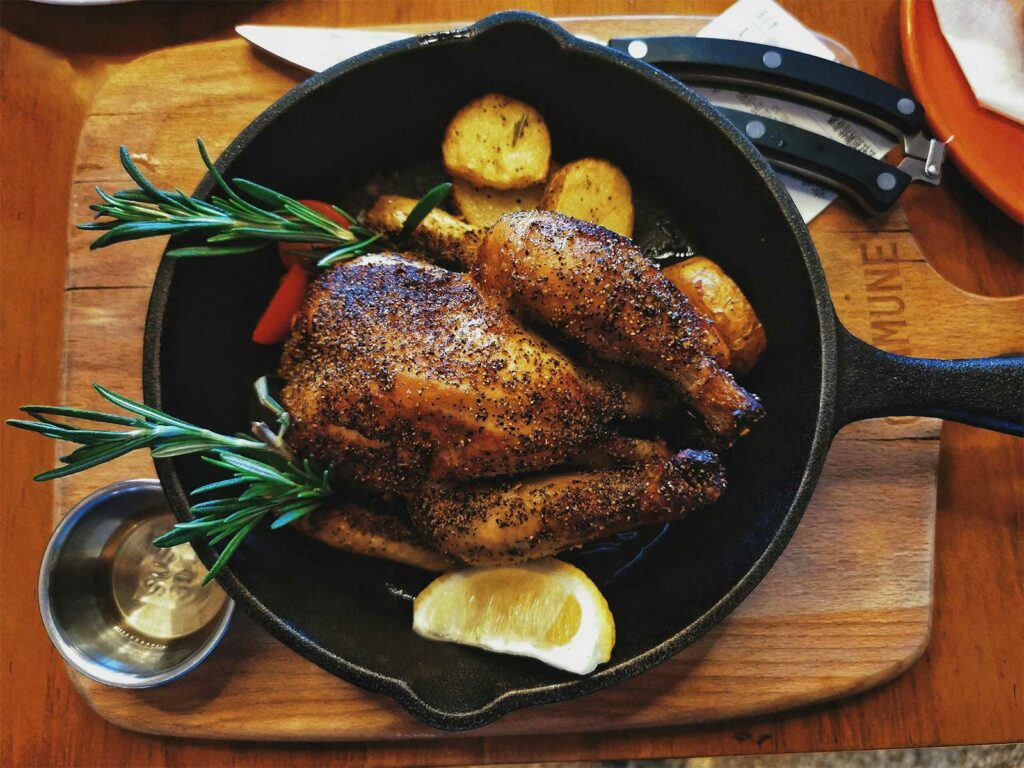
From Paris markets to U.S. kitchens, French rotisserie chicken is emerging as a model of simple, efficient nutrition.
A curious food trend is gaining momentum in the United States. It is not plant-based. It is not ultra-proteinized. It is not wrapped in wellness jargon. Instead, it looks deceptively old-fashioned: a whole roast chicken, slowly turning on a spit, seasoned simply, eaten with restraint. Inspired by the French poulet rôti du dimanche, Americans are rediscovering rotisserie chicken as a benchmark of nutritional efficiency. The appeal is not nostalgic fantasy. It is practical. A whole chicken delivers high-quality protein, fat in controlled amounts, minimal processing, and excellent caloric density per dollar. Research on satiety, muscle maintenance, and metabolic health increasingly supports this model. At a time when food inflation, diet fatigue, and distrust of ultra-processed products dominate public debate, the French rotisserie chicken appears as a rational answer. It is not a superfood. It is better than that. It is predictable, affordable, and biologically coherent. That, today, is enough to make it fashionable again.
The French Sunday chicken as a cultural and nutritional reference
In France, the poulet rôti is not a trend. It is a ritual. For decades, market rotisseries have sold whole chickens on Sundays. The bird is golden. The skin is crisp. The meat is moist. The sides are minimal. Potatoes. Green salad. Sometimes nothing else.
This meal has long been seen as ordinary. Abroad, it is now perceived as exemplary.
What Americans notice first is the simplicity. No sauces overloaded with sugar. No breading. No industrial marinades. Just heat, fat, salt, and time.
What nutritionists notice is efficiency. A standard French chicken weighs around 1.3 kg raw. After cooking, it yields about 850 g of edible meat. That provides roughly 1,400 kcal (5,860 kJ), around 180 g of protein, and fats that are naturally distributed between muscle and skin.
This is not diet food. It is nutritionally dense food.
The American rediscovery of whole protein sources
For years, American food culture favored separation. Chicken breasts without skin. Protein powders without food. Meals disassembled into macros.
That logic is cracking.
Recent consumer data show growing interest in whole foods that “do the job” without supplementation. Whole roast chicken fits perfectly. It delivers complete amino acid profiles, micronutrients such as vitamin B12, zinc, selenium, and iron, and fats that improve satiety.
Unlike isolated lean cuts, whole chicken reduces post-meal hunger. Studies consistently show that meals combining protein and fat slow gastric emptying and stabilize blood glucose.
The French model never removed the skin. It controlled the portion.
The perception of rotisserie chicken as peak nutritional efficiency
Efficiency is now a dominant food value. Not ethical perfection. Not culinary performance. Efficiency.
A whole chicken scores high on every metric Americans now care about.
Cost per gram of protein is low. In many U.S. supermarkets, a rotisserie chicken costs less than USD 7. That translates to under USD 0.04 per gram of protein. Few foods compete.
Preparation time is negligible. Waste is limited. Leftovers are flexible.
Most importantly, the food is self-limiting. One bird feeds several people or several meals. It discourages endless snacking.
This is where the French influence matters. The bird is shared. It is eaten at the table. It has a beginning and an end.
The contrast with ultra-processed “healthy” foods
American consumers are increasingly skeptical of products marketed as healthy. Protein bars. Low-fat meals. Ready-to-drink shakes.
Rotisserie chicken sits outside that ecosystem. It is recognizable. It is difficult to manipulate.
In France, rotisserie chickens are cooked in view of the customer. Transparency is literal. That visual trust is powerful.
When Americans seek to reproduce the French version, they are often disappointed by industrial rotisserie birds injected with saline solutions and flavor enhancers. The French reference becomes a standard of comparison.
The trend is not only about chicken. It is about processing avoidance.
The role of fat and skin in satiety and taste
French rotisserie chicken keeps the skin. This matters.
Chicken skin contains fat-soluble vitamins and provides flavor. More importantly, it slows consumption. Crisp skin demands chewing. It cannot be rushed.
From a metabolic perspective, fat increases satiety hormones. Meals without fat tend to trigger compensation later.
The French model accepts fat but limits quantity. A typical portion of roast chicken is about 150 g cooked. That includes skin. It provides roughly 350 kcal (1,460 kJ). That is manageable.
Removing skin often leads to larger portions. The paradox is obvious.
The Sunday meal as an anchor against dietary chaos
One overlooked aspect is rhythm.
The French Sunday chicken anchors the week. It is anticipated. It marks a pause. It is eaten slowly.
American nutrition research increasingly highlights the importance of structured meals. Irregular eating patterns correlate with weight gain, independent of calorie intake.
The rotisserie chicken, eaten as a proper meal, restores structure. It discourages grazing. It creates leftovers that are reused deliberately.
Efficiency is not only nutritional. It is behavioral.
The protein quality argument that convinces fitness circles
Fitness and performance communities are embracing whole roast chicken for different reasons.
Chicken protein has high digestibility. Its leucine content supports muscle protein synthesis. Unlike powders, it delivers these benefits with micronutrients intact.
A 150 g portion of roast chicken provides around 35 g of protein. That aligns with thresholds identified in sports nutrition research.
What surprises many is that adding skin does not negate these benefits. Total caloric intake remains controlled when meals are planned.
The French approach does not optimize. It balances.
The influence of French markets on American food imagination
Social media plays a role. Images of French markets. Rotisserie stands. Chickens turning slowly.
These images contrast sharply with American fast food aesthetics. They suggest patience. Craft. Care.
Food culture is not only nutritional. It is symbolic.
The French roast chicken symbolizes a rejection of extremes. It is neither indulgent nor restrictive. That middle ground is appealing in a polarized food environment.
The technical differences that matter in reproduction
Americans attempting to replicate French rotisserie chicken often miss key details.
Bird size matters. French chickens are smaller. Industrial U.S. chickens often exceed 2 kg. Larger birds cook unevenly.
Cooking temperature matters. Slow rotation at moderate heat preserves moisture.
Seasoning is minimal. Salt applied early. Fat bastes the meat naturally.
When these parameters are respected, the result is different. The efficiency improves. Waste decreases. Satisfaction increases.
This is not nostalgia. It is technique.
The broader implication for modern nutrition thinking
The rise of interest in French rotisserie chicken signals something deeper.
People are tired of abstraction. They want food that works without explanation.
A whole chicken does not need a label. It does not promise transformation. It delivers nourishment.
This challenges both industrial food systems and diet ideology. It suggests that progress may lie in selective regression.
Not backward. Just grounded.
Cook in France is your independant source for food in France.