Why French eating habits still defy obesity trends. Portion control, slow eating, and cultural discipline reshape nutrition science.
For decades, the “French Paradox” puzzled researchers. How could a population that eats butter, cheese, and drinks wine regularly remain slimmer and experience lower rates of cardiovascular disease than many Western peers? Today, the paradox has evolved. New research no longer focuses on mysterious metabolic protection but on how people eat, not only what they eat. French-style portion sizes, structured meals, slower eating speed, and social discipline at the table are now central to scientific debate. Studies on satiety hormones, meal timing, and eating pace show that smaller portions and slower consumption reduce total caloric intake without conscious restriction. This “French Paradox 2.0” aligns with modern nutrition science while challenging diet culture dogma. It suggests that pleasure, structure, and restraint can coexist. The implication is uncomfortable but clear: obesity is less about forbidden foods and more about behavioral context, portion management, and time spent eating. The French model is not magic. It is demanding, cultural, and learned. That may be why it works.
The original French paradox and its limits
The term “French Paradox” emerged in the early 1990s. Epidemiologists observed that France reported lower rates of coronary heart disease than the United States or the United Kingdom, despite a diet rich in saturated fat. Butter, cream, cheese, and charcuterie were daily staples. Average fat intake exceeded 35% of total energy intake, similar to other Western countries.
Early explanations leaned heavily on red wine. Polyphenols, particularly resveratrol, were thought to protect the cardiovascular system. This hypothesis aged poorly. Wine consumption alone could not explain population-wide differences. Moreover, similar wine intake in other countries did not produce the same outcomes.
What the original paradox missed was portion size, eating rhythm, and meal structure. These variables were rarely measured in early nutritional epidemiology. Today, they are central.
The portion sizes that quietly change everything
French portions are objectively smaller. This is not folklore. Comparative data show that a typical restaurant main course in France contains 20% to 30% fewer calories than its American equivalent. A croissant weighs about 55 g. A standard baguette portion at a meal is often 60 g to 80 g, not the full 250 g loaf.
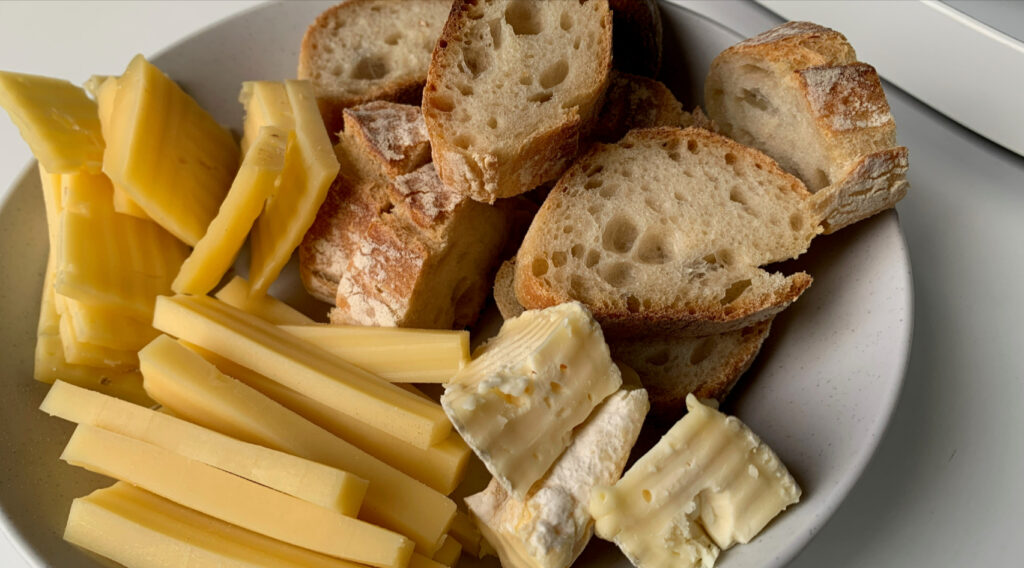
Cheese offers a striking example. In France, a cheese portion averages 30 g. In many Anglo-Saxon countries, servings exceed 60 g. That difference alone represents roughly 120 kcal (500 kJ) per serving. Over a week, it matters.
This restraint is cultural, not nutritional. French diners do not label foods as “good” or “bad.” They limit quantity. Portion control is implicit, not moralized.
The slow eating effect on metabolism and satiety
Eating speed has become a major research topic. Multiple clinical studies show that slower eating increases satiety hormones such as peptide YY and glucagon-like peptide-1. It also reduces ghrelin, the hormone associated with hunger.
A slow meal typically lasts 20 to 30 minutes. This delay allows the gut-brain axis to signal fullness. Fast eaters often consume excess calories before satiety registers.
French meals are slow by design. Courses are sequential. Conversation interrupts eating. Plates are cleared between dishes. There is no grazing. No eating in cars. No screens at the table.
One controlled trial showed that participants eating slowly consumed about 10% fewer calories per meal, roughly 120 kcal (500 kJ), without reporting greater hunger later. Over time, this difference is decisive.
The structured meals that prevent mindless calories
Snacking culture differs sharply. In France, daily caloric intake is concentrated into three meals. Snacking is limited and socially discouraged, especially in adults.
This structure reduces decision fatigue and random calorie intake. In contrast, unstructured eating leads to frequent insulin spikes and higher total energy consumption.
Children illustrate this clearly. French school lunch programs emphasize seated meals lasting at least 30 minutes. Portions are fixed. Desserts are included, but in small amounts. Long-term data show lower childhood obesity rates compared with countries where ultra-processed snacks dominate between meals.
The message is blunt: structure beats restriction.
The role of pleasure without excess
French food culture prioritizes pleasure, but within limits. Meals are anticipated, shared, and respected. This emotional framing reduces compensatory overeating.
Neuroscience supports this. Anticipation and satisfaction activate dopamine pathways differently than impulsive eating. When pleasure is planned, the reward threshold is lower. When eating is rushed or distracted, people chase satisfaction with quantity.
This explains why deprivation-based diets often fail. The French model allows butter and cheese, but denies mindless repetition.
The wine question revisited with realism
Wine still matters, but not for the reasons once claimed. Average wine consumption in France has declined sharply, falling below 40 L per capita per year. Consumption is regular but moderate. Typical intake is one glass, about 120 ml, with meals.
Alcohol contributes calories, about 85 kcal (360 kJ) per glass. Yet it replaces other caloric beverages and is rarely consumed alone. There is little binge drinking during meals.
Research now suggests that wine’s role is behavioral, not biochemical. It slows eating. It anchors meals. It discourages snacking afterward.
The idea that wine “burns fat” is fiction. The reality is less glamorous and more convincing.
The contrast with diet culture and ultra-processed foods
The French approach clashes with modern diet narratives. There is no calorie counting. No protein obsession. No fear of fat. Yet obesity rates remain lower.
One reason is lower exposure to ultra-processed foods. While availability has increased, consumption remains below that of many industrialized countries. Ultra-processed foods are designed for speed, softness, and overconsumption.
French meals resist this design. Texture matters. Chewing takes time. Sauces are rich but portioned. Food is eaten, not inhaled.
The scientific shift toward behavioral nutrition
Nutrition science is moving away from nutrient reductionism. Calories, macros, and food labels explain little without behavior. The French Paradox 2.0 fits this shift.
Recent cohort studies show that eating speed, meal regularity, and portion size predict weight gain more reliably than fat intake alone. These findings are uncomfortable for the diet industry. They offer no miracle product.
They do, however, offer a realistic path. Eat slowly. Eat less. Eat better. Do not panic.
The economic and social dimensions often ignored
French meals take time. That time has a cost. Lunch breaks last longer. Cooking is valued. Eating is protected from productivity pressure.
This model is harder to replicate in societies obsessed with speed. It demands cultural change, not individual willpower.
That may explain resistance. It is easier to sell supplements than patience.
The limits and myths that deserve honesty
France is not immune to obesity. Rates have risen, especially among younger populations exposed to globalized food systems. The paradox is weakening.
Moreover, the model is not universally applicable. Shift workers, low-income households, and urban lifestyles face constraints. Romanticizing the French table solves nothing.
Still, the data remain clear. When the model is applied, it works.
The future of the French paradox in global nutrition
The renewed interest in slow eating and portion control reflects fatigue with extreme diets. People want sustainability.
The French Paradox 2.0 offers no shortcuts. It offers discipline without misery. Pleasure without excess. Science without hype.
That may be its greatest challenge. It asks people to change how they live, not what they buy.
Cook in France is your independant source for food in France.