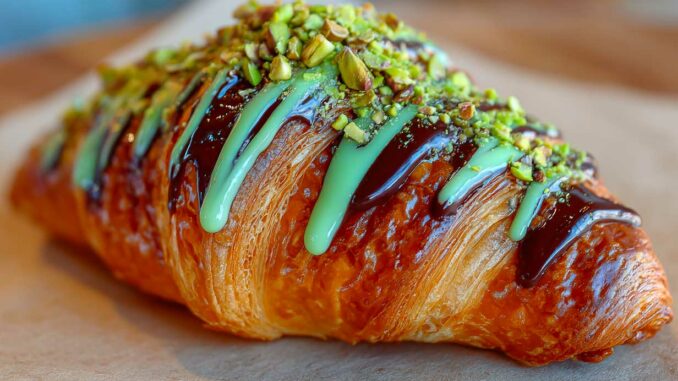
The Dubai Chocolate Crookie blends crookie hype with pistachio-kataifi crunch. Here is why it went viral, and what it reveals about pastry today.
The Dubai Chocolate Crookie is not “just another viral pastry.” It is a clean illustration of how modern food trends spread and mutate. First, a “crookie” (croissant plus cookie dough) proved that people will queue for a texture clash. Crisp laminated layers. Soft cookie center. A format made for cross-sections and short videos. Then the “Dubai chocolate” flavor code arrived. Pistachio cream, chocolate ganache, and toasted kataifi (shredded phyllo) bring a new crunch and a Middle Eastern reference many consumers now recognize. Social platforms did the rest. Celebrities posted versions. Major brands reacted. In late 2025, the Dubai chocolate bar concept had become so mainstream that even limited-edition mass-market launches were built around it. The crookie format is the perfect delivery system: buttery, portable, photogenic, and easy to price high. The result is a hybrid that sells an experience as much as it sells pastry.
The crookie’s rise that set the stage for the mash-up
A viral product needs a simple base concept. The crookie has one. It is a croissant baked with cookie dough. The payoff is immediate. You get a flaky shell and a soft, chocolatey core in one bite. That contrast reads well on camera. You can show it with one cut.
The crookie wave also proved a blunt point. People will pay for novelty if the texture is convincing. In Paris, Maison Louvard is widely cited as the origin point of the early-2024 crookie surge. Media coverage framed it as the next “hybrid pastry” moment after the cronut era. Some reporting even cited very high daily volumes once the trend hit peak visibility, which matters because it shows demand was not niche. It was mass behavior.
The crookie is also operationally clever. It uses existing viennoiserie infrastructure. A bakery already laminates dough. A bakery already bakes off trays fast. Adding cookie dough is not trivial, but it is manageable. This is why the format spread quickly across cities.
The “Dubai chocolate” flavor code that turned into a global shortcut
The second half of the story is the flavor code people now call Dubai chocolate. In practice, it is a recognizable trio: pistachio cream, chocolate, and toasted kataifi. It is strongly associated with a viral chocolate bar originally credited by many outlets and recipes to Fix Dessert Chocolatier in Dubai.
The appeal is not mysterious. Pistachio brings fat, aroma, and a “luxury” signal. Chocolate ganache adds depth and softness. Kataifi brings a brittle, audible crunch that survives inside rich fillings if it is toasted and kept relatively dry.
By late 2025, the Dubai chocolate idea had become a template that others could legally reinterpret. It showed up in home baking, in restaurant desserts, and in mass-market innovation. A single celebrity post can move the needle, and in December 2025, a viral TikTok from Billie Eilish sharing a Dubai chocolate-style recipe reportedly crossed 100 million views. That is not a pastry trend. That is global distribution.
Brands noticed. Hershey’s even launched a limited Dubai-inspired bar with pistachio and kadayif, capped at 10,000 units. That kind of scarcity play is a signal that executives believe the flavor has marketing power on its own.
The crookie format that makes the Dubai flavors perform better
The Dubai chocolate profile is rich. If you put it in a plain cookie, it can read as heavy. If you put it in a simple croissant, it can turn cloying if the filling is too sweet. The crookie format fixes that by design.
A well-made croissant has built-in aeration. Layers create space. That space lets strong fillings taste less dense. The cookie component adds chew and chocolate notes that bridge to ganache. The pastry becomes a multi-texture vehicle rather than a one-note sugar bomb.
This is why the Dubai Chocolate Crookie works as a “system.” You have:
- laminated crispness on the outside,
- soft cookie density inside,
- creamy pistachio filling,
- ganache smoothness,
- kataifi crunch spikes.
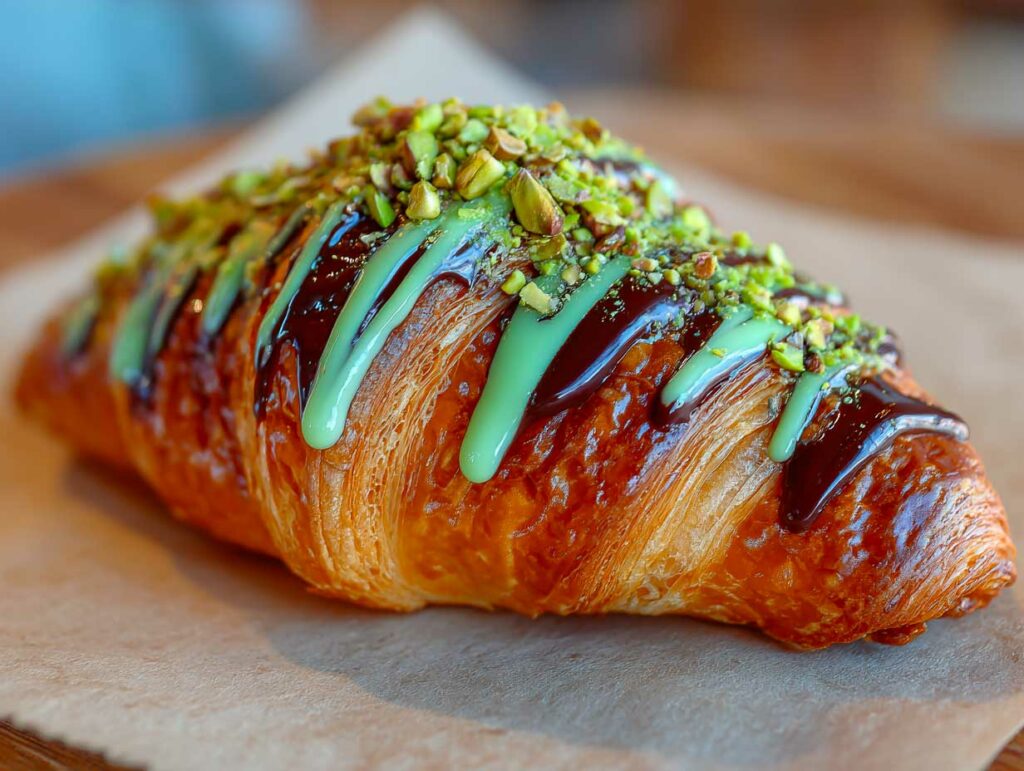
That stack is engineered for repeat bites. It is also engineered for filming. The kataifi strands look dramatic. The pistachio green reads instantly. The ganache shine signals indulgence. This is food built for algorithms.
The technical choices that separate a real product from a gimmick
Here is the part most viral coverage skips. If you build this badly, it is a mess.
First issue: moisture migration. Kataifi turns limp if it absorbs moisture from pistachio cream or ganache. The fix is to toast it properly, coat it lightly with fat, and let it cool fully before assembly. You want it crisp and sealed, not steamed.
Second issue: bake management. Cookie dough in a croissant raises the risk of underbaking. A croissant bakes from the outside in. Cookie dough wants time to set without burning. Many bakeries solve this by using smaller dough quantities, or by baking at controlled temperatures with longer time, then finishing with a brief high-heat blast for color. If you rush it, the center stays pasty.
Third issue: fat balance. Pistachio cream varies wildly. Some versions are basically pistachio butter. Others are pistachio plus sugar and milk solids. If the cream is too loose, it leaks. If it is too stiff, it eats like plaster. Many recipes stabilize with white chocolate or a little tahini, which also adds bitterness.
Fourth issue: portion discipline. Viral pastries often fail because they go too far. The crookie already delivers butter and sugar. Adding thick ganache plus sweet pistachio cream can become oppressive. The better versions use acidity elsewhere (a pinch more salt, a darker chocolate, or a less sweet pistachio base).
The price dynamics that make the trend spread fast
A hybrid pastry can be priced higher because it looks complex. That is the uncomfortable truth. A croissant is familiar. A cookie is familiar. Combine them, add pistachio and kataifi, and suddenly it feels like a “signature.”
Pistachio is also expensive relative to common pastry nuts. Kataifi is specialized. Ganache uses real chocolate. Even if the ingredient cost is not insane per unit, the perception of luxury is strong. This is how you get a product that supports premium pricing without requiring fine-dining labor.
There is also a scarcity effect. A bakery can only laminate so many croissants per morning. If a crookie sells out at noon, the sell-out becomes marketing. It is a loop that reinforces itself.
The cultural pull behind the obsession
People are not only chasing sugar. They are chasing references.
The crookie carries a “Paris bakery” aura even when made elsewhere. It borrows credibility from French viennoiserie craft. The Dubai chocolate profile adds a Middle Eastern reference that many consumers now associate with modern luxury, travel, and gift culture. The fusion is a social signal: global, trendy, and “in the know.”
This is why “Dubai chocolate” jumped categories so quickly. It is not tied to one traditional dessert name. It is a flexible flavor identity. You can put it in a tart, cookies, bars, lattes, and now crookies. When Starbucks itself highlights a Dubai-chocolate-inspired drink as one of the year’s most viral items, it tells you the term has entered mainstream consumer language.
The practical guide to eating and pairing it like an adult
If you want to enjoy it, treat it like a rich plated dessert, not a casual snack.
Serve it warm, not hot. Around 35–40°C (95–104°F) is ideal. Ganache softens. Aromas lift. Kataifi still crunches if it was built correctly.
Slice it with a serrated knife. Do not crush it. You want clean layers.
Pairing needs honesty. Milk drinks can flatten it. A straight espresso works because bitterness cuts fat. For tea, choose black tea with structure, or mint tea if you want freshness.
If you insist on wine, go dry. A high-acid white can reset the palate. A sweet pairing can turn it syrupy fast. The crookie already has sugar. Do not pretend it needs more.
The signals this trend sends about where pastry is heading
The Dubai Chocolate Crookie is not the end point. It is a blueprint.
Expect more “format plus flavor code” mash-ups. A familiar pastry structure. A globally legible flavor identity. A visible texture element designed for sound and crunch on video.
Also expect more backlash. Some of these products are genuinely good. Many are lazy copies that rely on sugar, green color, and hype. Consumers will learn the difference.
The bigger point is uncomfortable for purists. Viral pastry is now part product, part media object. If it cannot be explained in one sentence and shown in one cut, it struggles. The Dubai Chocolate Crookie can. That is why everyone is talking about it.
Cook in France is your independant source for food in France.