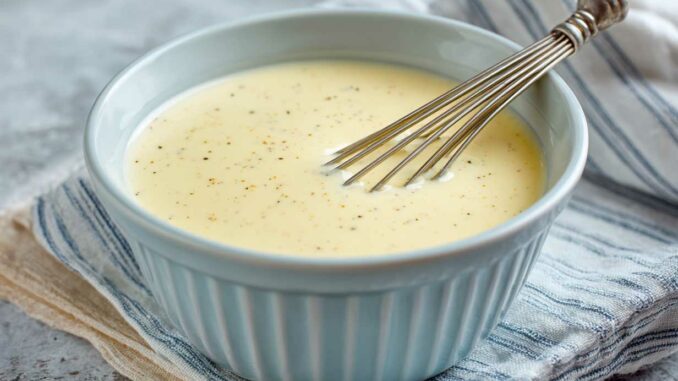
A precise, professional guide to béchamel sauce: origins, purpose, correct technique, ratios, errors to avoid, and variations for every culinary use.
Béchamel sauce is one of the foundations of classical European cuisine. It is simple in composition but demanding in execution. Made from milk, butter, and flour, it works because of balance, temperature control, and patience. A proper béchamel is smooth, stable, and neutral. It must coat without masking, support without dominating. This sauce is not about improvisation. Ratios matter. Heat matters. Timing matters. When done correctly, béchamel becomes a structural element in dishes such as lasagna, gratins, soufflés, croque-monsieur, and countless derived sauces. When done poorly, it turns grainy, heavy, or tasteless. This article explains what béchamel sauce is, what it is used for, how to make it correctly step by step, and how to adapt it for different culinary purposes. The goal is clarity and control, not shortcuts. Mastering béchamel means mastering one of the key mechanics of French cooking.
The origin and role of béchamel sauce
Béchamel is one of the five “mother sauces” codified in classical French cuisine. Its role is technical, not decorative. It provides structure, moisture, and cohesion.
Historically, béchamel developed as a refined white sauce using milk instead of stock. This choice gives it neutrality. Unlike sauces based on meat reductions, béchamel adapts to vegetables, pasta, fish, poultry, and eggs.
Its function is clear. It binds ingredients. It protects food from drying in the oven. It acts as a base for richer or more complex sauces. It is not meant to shine on its own.
A correct béchamel is invisible in effect but essential in result.
The purpose of béchamel in cooking
Béchamel is not a sauce you drizzle. It is a sauce you integrate.
Its primary uses are threefold.
First, it acts as a binding sauce. In lasagna or baked pasta, it links layers and distributes moisture evenly.
Second, it functions as a protective coating. In gratins, it prevents vegetables or pasta from drying under heat.
Third, it serves as a neutral base. Many classical sauces are béchamel derivatives, adjusted for flavor, richness, or texture.
Because of this, béchamel must stay neutral. Over-seasoning or excessive fat breaks its purpose.
The correct ingredients and ratios
Béchamel relies on precision. There are no flexible ratios.
The classical ratio for standard béchamel is:
– 50 g butter
– 50 g flour
– 500 ml whole milk (0.5 L)
This produces a medium-thick sauce suitable for gratins and layered dishes.
For lighter applications, such as soufflés or vegetable coatings, reduce flour to 40 g per 500 ml.
For thicker applications, such as croquettes or stuffing, increase flour to 60 g per 500 ml.
Milk must be whole. Semi-skimmed milk weakens texture. Cream is not béchamel.
Butter must be unsalted to control seasoning.
Flour must be plain wheat flour. No starch substitutes belong in classical béchamel.
The technique that makes or breaks the sauce
The roux as structural foundation
Béchamel begins with a white roux. Butter is melted gently, then flour is added.
The key rule is simple. The flour must cook without browning.
Cook the butter over medium-low heat. Add flour at once. Stir continuously for 2 to 3 minutes.
You are not frying. You are eliminating raw flour taste.
The roux should look pale, smooth, and slightly foamy. Any color change is a mistake.
The milk temperature debate
Milk temperature matters more than people admit.
There are two correct methods.
Either add hot milk to warm roux, or add cold milk to hot roux. Both work if done consistently.
What fails is warm milk added slowly to lukewarm roux. That creates lumps.
The safest professional method is hot milk. Heat milk to about 70 °C (158 °F). Do not boil.
Add it in two or three additions, whisking vigorously each time.
This creates instant emulsification and prevents starch clumping.
The thickening phase
Once milk is incorporated, raise heat slightly and continue stirring.
The sauce will thicken between 85 and 90 °C (185–194 °F). Below that, starch does not activate fully.
Stir constantly, especially around the edges.
Once thickened, reduce heat and simmer gently for 8 to 10 minutes. This step is not optional.
It removes residual flour taste and stabilizes texture.
The seasoning rules professionals follow
Béchamel seasoning is restrained.
Salt is mandatory. Add gradually.
White pepper is traditional. Black pepper leaves visual specks.
Nutmeg is optional but classical. Use freshly grated nutmeg, no more than a pinch.
Onion, bay leaf, or clove can be infused into the milk, then removed. This adds depth without contamination.
Garlic does not belong in classical béchamel.
Cheese does not belong in béchamel. Once cheese is added, it becomes another sauce.
The common mistakes that ruin béchamel
Most béchamel failures come from impatience.
Lumps are caused by incorrect temperature pairing or insufficient whisking.
Thin sauce comes from incorrect ratios or undercooking.
Gluey texture comes from overheating after thickening.
Grainy texture comes from reheating without dilution.
If béchamel becomes too thick, add hot milk slowly while whisking. Never add cold milk at the end.
If lumps appear, pass the sauce through a fine sieve or use a hand blender briefly.
The main types of béchamel by usage
The light béchamel for vegetables and fish
This version uses lower flour content, around 40 g per 500 ml.
Texture should coat lightly, not mask.
Ideal for cauliflower, leeks, spinach, white fish, or eggs.
Season lightly. Let ingredients speak.
The standard béchamel for gratins and pasta
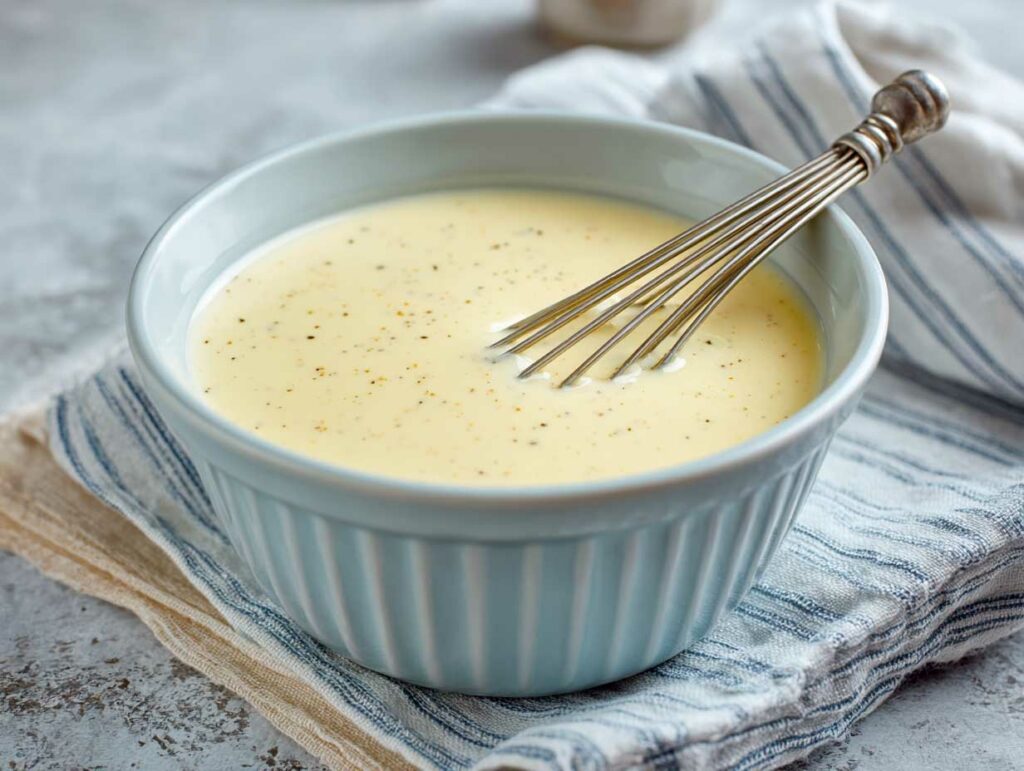
This is the reference ratio of 50 g flour per 500 ml milk.
Used for lasagna, baked pasta, endives au gratin, and croque-monsieur.
It must hold shape without stiffness.
This is the most widely used version.
The thick béchamel for stuffing and croquettes
Here flour rises to 60 g or even 70 g per 500 ml.
Texture should be dense and stable when cooled.
Used for croquettes, quenelles, or savory fillings.
This béchamel must cool fully before use.
The enriched béchamel for soufflés
Egg yolks are added off heat, after thickening.
Ratio remains moderate. Texture must stay smooth.
This base supports volume without collapsing.
Egg whites are incorporated separately later.
The classic sauces derived from béchamel
The Mornay sauce
Béchamel plus cheese. Usually Gruyère, Comté, or Parmesan.
Cheese is added off heat to avoid splitting.
Used for gratins, vegetables, eggs, and seafood.
This is the most famous derivative.
The Nantua sauce
Béchamel enriched with crayfish butter and cream.
Used traditionally with fish or quenelles.
Rich but controlled.
The Soubise sauce
Béchamel with slow-cooked onions puréed into it.
Used with meats or vegetables.
Sweetness comes from onion, not sugar.
These sauces work because béchamel is neutral and stable.
The storage and reheating rules
Béchamel does not like neglect.
To store, cover surface with film touching the sauce. This prevents skin formation.
Keep refrigerated for up to 48 hours.
To reheat, add a small amount of milk and heat gently while whisking.
Never microwave aggressively. It breaks emulsion.
Never boil once reheated.
Why béchamel still matters today
Béchamel is unfashionable, and that is precisely why it matters.
It teaches control. It forces respect for ratios, temperature, and time.
It cannot be rushed. It cannot be hidden.
In modern kitchens obsessed with shortcuts, béchamel remains a technical checkpoint.
Mastering it does not make you creative. It makes you reliable.
And in cooking, reliability is often the difference between competence and mastery.
Cook in France is your independant source for food in France.