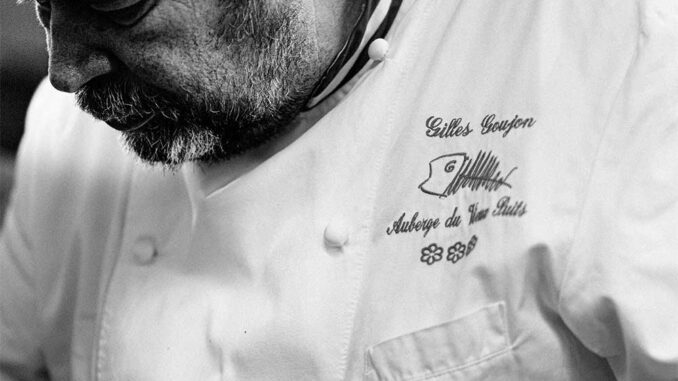
Discover Gilles Goujon’s path to three Michelin stars, his Languedoc terroir focus, signature dishes, and what diners can expect at L’Auberge du Vieux Puits.
A chef’s portrait in southern France
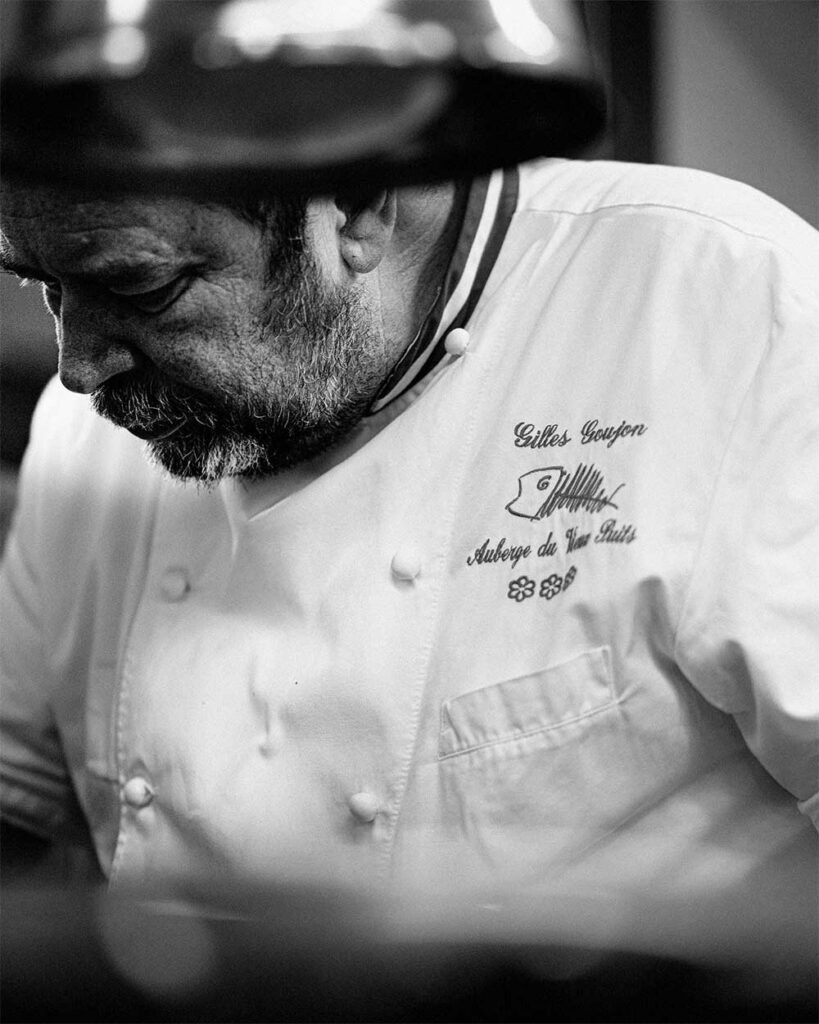
Few modern French chefs illustrate the link between discipline, place, and product as clearly as Gilles Goujon. Born in 1961, he built his reputation through exacting work and a methodical approach rooted in the flavors of southern France. His flagship restaurant, L’Auberge du Vieux Puits, sits in Fontjoncouse, a small village in the Aude department. It is not a fashionable metropolis address. That is precisely the point.
Goujon’s story is often told as a triumph of talent over geography. The more accurate reading is tougher and more useful: he treated geography as a competitive advantage. By anchoring his cooking in local seasonality, close relationships with artisans, and rigorous technique, he turned an unlikely destination into a reference for French gastronomy. The Michelin Guide awarded the restaurant its third star in 2010, after a steady rise that signals long-term consistency rather than a sudden breakthrough.
This profile looks at his trajectory, his influences, and the dishes most closely associated with his style—while also giving practical details for readers who want to understand what “three Michelin stars” means on a plate, in a dining room, and in a kitchen.
The career path behind a three-star kitchen
From early jobs to professional discipline
Gilles Goujon is originally from Bourges, where he spent his early years. His interest in hospitality first took shape through hands-on work: he encountered professional kitchens as a server and then as a trainee cook. He began with studies oriented toward manual trades, but ultimately committed fully to cooking.
He trained through regional culinary schools that gave him technical fundamentals: managing precise cooking temperatures, breaking down meat, and building sauces. Those skills matter more than they sound. In haute cuisine, the “signature” you see on the plate depends on invisible repetition behind the scenes: stocks reduced to the right viscosity, meat rested and carved consistently, sauces mounted at the correct moment. A three-star restaurant is rarely a place where improvisation is rewarded.
Learning inside brigades and star systems
During his apprenticeship and early years, Goujon worked within multiple brigades, from traditional restaurants to gastronomic houses. He held different positions—commis, then second—before leading teams of his own. Along the way, he worked with established chefs, including figures connected to Michelin-star traditions, where standards are uncompromising.
This period shaped two defining traits in his career: an insistence on precise technique and a belief that fundamentals are non-negotiable. Goujon’s own philosophy reflects that mindset. He has often emphasized the importance of mastering basics—broths, reductions, slow cooking, structured sauces—before chasing novelty. It is not a nostalgic stance. It is a production logic: the more complex the service, the more you need reliable fundamentals.
Why Fontjoncouse became the turning point
His encounter with the Languedoc-Roussillon terroir was decisive. In settling in the region, he committed to sourcing close to Fontjoncouse and to building menus around what the Aude could provide. When he arrived at L’Auberge du Vieux Puits, the location was not a “destination” in the usual luxury sense. He helped transform it into one.
That transformation did not come from branding. It came from coherence. A guest traveling to Fontjoncouse expects a meaningful relationship between the plate and the landscape. Goujon made that relationship the core of the restaurant’s identity.
The influences that shaped Gilles Goujon’s style
A southern terroir as a creative engine
Goujon’s first influence is the south itself: the produce, the livestock, and the rhythm of the seasons around Fontjoncouse. He regularly highlights ingredients found close to home, including black truffle from the Aude, lamb from the Corbières area, and local farmhouse cheeses.
This is not simply “farm-to-table” as a slogan. In a three-star setting, local sourcing becomes a technical constraint. A chef must adapt to variations in size, fat content, maturity, and yield. Building a menu on such ingredients requires control of technique and a willingness to adjust—sometimes daily.
Classical French technique, used without theatrics
His work in starred houses exposed him to chefs committed to traditional French cooking. That influence appears in his emphasis on accurate doneness, structured sauces, and clear flavor lines. You see it in dishes where the “reading” is immediate: a product presented honestly, enhanced by a sauce that makes sense, finished with garnishes that add texture rather than distraction.
At the same time, Goujon is not locked in the past. Contemporary touches appear through lighter presentations, more refined plating, and the occasional use of airy preparations. The difference is that these techniques serve clarity rather than spectacle. The goal is not to surprise at any cost. The goal is to deliver precision.
The producer relationship as a practical system
Another key influence is his sustained relationship with producers. Goujon regularly visits farms and vineyards in the Aude. These exchanges feed creativity in a concrete way: they shape what is available, when it is at its peak, and how it should be handled.
This producer network also supports what many diners underestimate: predictability. In fine dining, consistency is not only a kitchen issue. It is also a supply issue. Strong local partnerships reduce uncertainty and make seasonal menu planning more realistic.
Transmission as a professional culture
Goujon is also known for focusing on the next generation. His influence includes a didactic approach to training, encouraging cooks to master foundational techniques while exploring modern methods. In practice, this means a kitchen culture where young chefs learn not only recipes but also standards: how to season, how to taste, how to repeat.
That training culture is a form of legacy. In high-level kitchens, the chef’s style is preserved through the habits he builds into the team.


The signature dishes diners associate with him
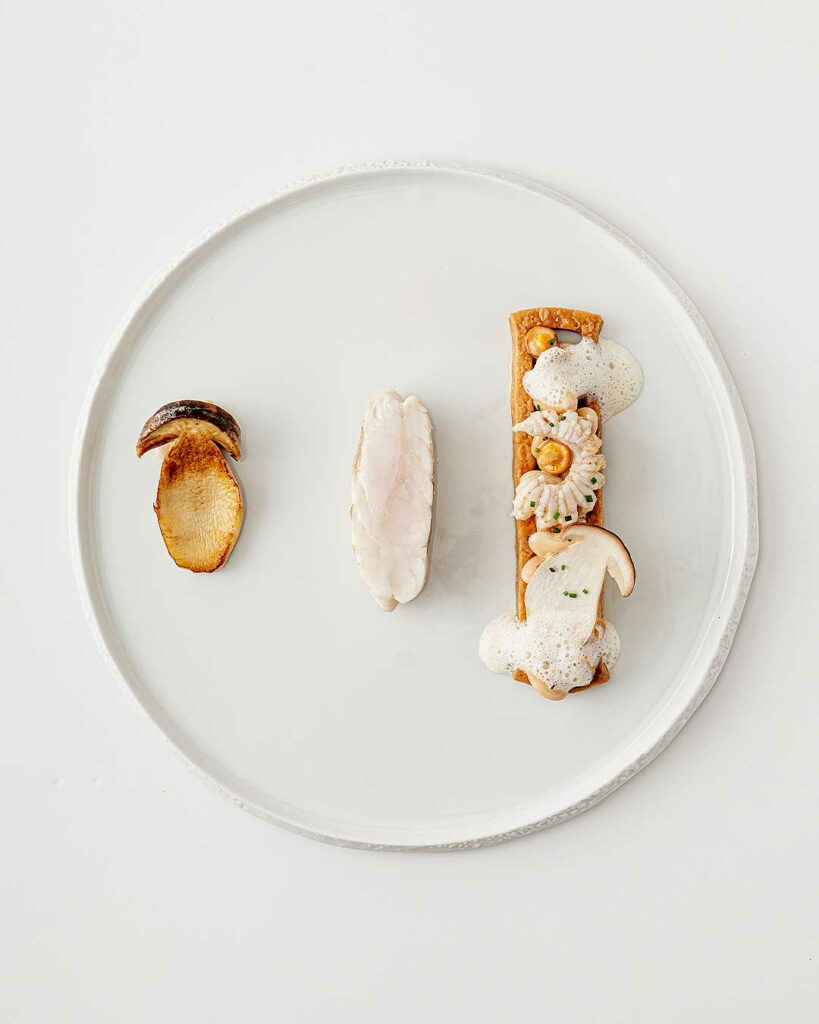
A Michelin-starred chef is often reduced to one “iconic” plate. In Goujon’s case, several dishes repeatedly appear in accounts of the restaurant, each reflecting a specific technical idea.
The truffle-perfumed “rotten” egg
One of Goujon’s most cited creations is the truffle-perfumed egg often nicknamed the “rotten” egg. The technique is simple to explain and difficult to execute well. The egg is placed in a sealed container with truffles. Over time, the aroma permeates the shell. The egg is then cooked at low temperature and served with a rich cream-based sauce and truffle pieces.
It is a study in controlled intensity. The plating is restrained, because the point is the fragrance and the texture: the soft egg, the richness of the sauce, the unmistakable truffle character.
Roasted pigeon with controlled doneness
Another recurring reference is roasted pigeon cooked to preserve tenderness. Here the signature is not an exotic ingredient but accurate timing. The bird is paired with seasonal vegetables and often supported by reduced cooking juices. Textural contrasts matter: crisp elements against softer notes, with a sauce that binds the plate together.
In many menus, a dish like this sits in a premium price band. In the text you provided, it is mentioned around €80 to €100 depending on the menu configuration. That price signals the level of product, the labor involved, and the complexity of service.
A bouillabaisse reworked with discipline
Bouillabaisse is a dish that can become a caricature. Goujon’s approach is to keep the structure clear: fresh fish, shellfish, aromatic vegetables, rouille, and an organized, legible broth. The composition can shift with daily arrivals, but the framework remains consistent. In practice, that is a technical stance. A “variable” dish still needs a stable identity.
Desserts that keep tradition, with lighter execution
Goujon’s desserts often connect to classic French pastry while staying light in feel. A crisp strawberry millefeuille, for example, nods to tradition but depends on precise lamination, controlled sweetness, and high-quality fruit. In a three-star context, dessert is not an afterthought. It must close the meal with the same clarity as the savory courses.
The milestones and recognition that define his standing
A clear Michelin trajectory
At L’Auberge du Vieux Puits, the Michelin path is documented as a progression: first star in 1997, second in 2001, and the third in 2010. That timeline matters because it suggests sustained improvement and long-term consistency. Three stars are rarely awarded to a restaurant that is merely “good.” They are awarded to a restaurant seen as a destination in itself.
Honors beyond Michelin
Goujon was named Meilleur Ouvrier de France in 1996, a distinction that carries weight within the craft culture of French cuisine. He is also cited in specialist guides such as Gault & Millau, which has awarded the restaurant 5 toques.
He participates in gastronomic events, sometimes sits on juries for young-chef competitions, and remains connected to initiatives that promote regional products. These roles reinforce his public image, but they also signal professional credibility: peers trust his judgment.
Wine, the Aude, and the dining room experience
A practical point for diners is the restaurant’s relationship with local wines. The text highlights close ties with regional winemakers, enabling careful wine pairing choices that complement the cooking. In a three-star setting, that pairing is not only about prestige bottles. It is about coherence with the menu’s flavors and textures.
Service is described as attentive and convivial, which is a useful clue. Many diners fear three-star formality. Goujon’s house is often portrayed as precise without being distant.
Practical expectations for diners
A profile is useful only if it helps readers understand what they would actually experience.
Menus at L’Auberge du Vieux Puits are described as ranging from €100 to over €200, depending on the chosen formula. That band aligns with what many Michelin three-star restaurants charge for tasting menus in France, though the exact offers and pricing can evolve seasonally.
The key practical expectation is seasonality. The menu changes with local production and arrivals. If you go expecting the same plate year-round, you will misunderstand the restaurant. The point is the relationship to place.
Another practical point is that a restaurant of this level is a system. The “chef’s genius” is not only a personal trait. It is reflected in sourcing, staff training, repetition, and the discipline to keep standards high over years.
The legacy beyond the dining room
Goujon’s legacy is tied to transmission. He has trained cooks who later took on significant responsibilities elsewhere, carrying forward an approach built on clarity, precise cooking, and disciplined use of regional ingredients.
He is also involved in charitable actions and associative projects, supporting structures that help train cooks facing difficulties and improve access to professional integration. He sometimes participates in solidarity meals and educational initiatives, using culinary expertise in concrete ways rather than abstract messaging.
Finally, he appears in media formats—television and radio—where he tends to speak about practical subjects: ingredient selection, cooking methods, and respect for terroir. That practicality is consistent with his culinary identity.
A chef’s fame can be loud. Goujon’s case is quieter and more instructive. His career suggests that excellence does not always come from reinvention. It can come from a stubborn commitment to fundamentals, applied with local intelligence, until a remote village becomes a reference point on the map of fine dining in southern France.
Cook in France is your independant source for food in France.