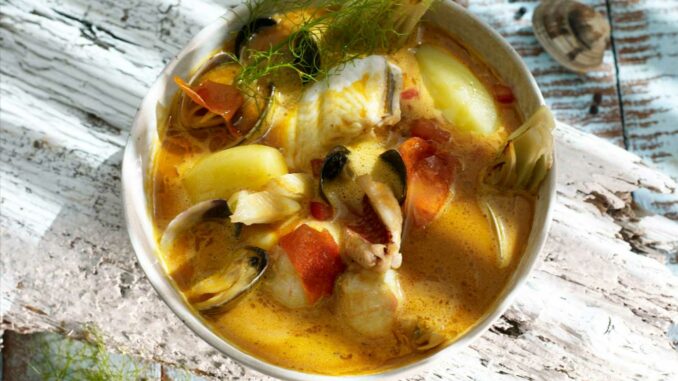
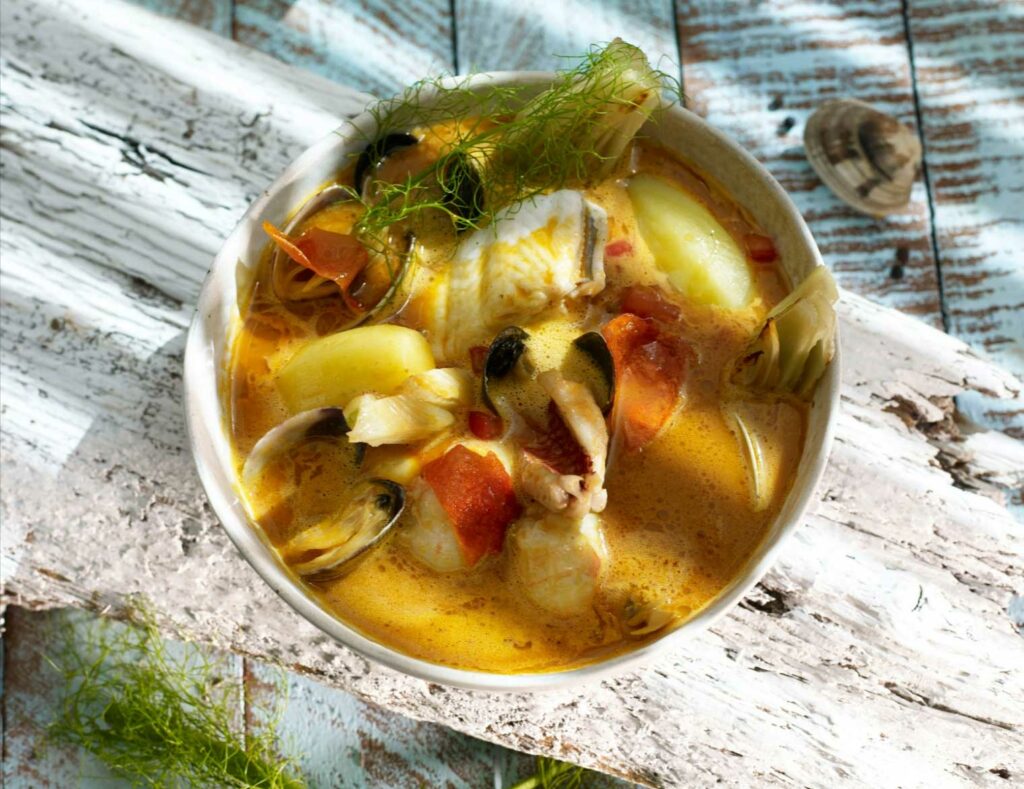
Bouillabaisse is more than a fish stew. It is a culinary ritual that emerged from the port of Marseille and became one of the most recognizable dishes of southern France. Rooted in the daily life of fishermen and shaped by centuries of Mediterranean trade, bouillabaisse reflects both necessity and refinement. It combines local rockfish, shellfish, olive oil, saffron and aromatic herbs in a cooking method that is precise and layered. What began as a humble meal has evolved into a gastronomic emblem of Provence. Understanding bouillabaisse means understanding Marseille itself.
The Origins in the Fishing Ports of Provence
Bouillabaisse was born in the working-class neighborhoods of Marseille. Fishermen returning from sea would set aside the less marketable fish—those too bony or irregular to sell fresh at the port. Instead of wasting them, they simmered these fish with seawater, wild fennel, garlic and olive oil.
The name itself reflects the technique. It derives from the Provençal words “bolhir” (to boil) and “abaissar” (to lower or simmer). The broth is first brought to a vigorous boil and then reduced to a gentler simmer. This two-step process defines the dish.
By the 19th century, bouillabaisse had moved beyond the docks. As Marseille expanded through maritime trade, wealthier families adopted the dish. It became more structured, with codified ingredients and a clearer separation between broth and fish. What had once been improvisation became culinary identity.
Today, bouillabaisse is widely regarded as a cornerstone of Provençal cuisine. It represents the Mediterranean’s flavors in concentrated form.
The Essential Ingredients and Their Function
Authentic bouillabaisse relies on specific Mediterranean fish. Tradition calls for at least four varieties, often more. Among the most prized is rascasse, or scorpionfish, valued for its firm flesh and intense flavor. Other common fish include conger eel, red mullet and sea robin.
These rockfish contribute collagen and gelatin to the broth. Their bones and heads release depth during simmering. Without them, the broth lacks structure.
Olive oil forms the aromatic base. Garlic, tomatoes and fennel build the vegetal profile. Saffron adds color and subtle bitterness. Orange zest is sometimes included to brighten the broth.
Fresh herbs such as thyme and bay leaf are used sparingly. The goal is not complexity through abundance, but clarity through balance.
Shellfish may appear in some versions, but purists argue that true bouillabaisse centers on fish rather than crustaceans.
The Method That Defines the Dish
Bouillabaisse is prepared in stages. The broth comes first.
Fish heads, bones and smaller fish are simmered with vegetables, herbs and saffron in a large stockpot. The liquid must boil briefly, then simmer for around 30 to 45 minutes. This extracts flavor while preventing bitterness.
The broth is then strained through a fine sieve. Some cooks press the solids to intensify the stock.
The second stage involves cooking the larger fish pieces. These are added in sequence according to firmness. The goal is precise cooking. Overcooking would destroy texture.
Timing is critical. Fish may cook in as little as 8 to 12 minutes depending on thickness.
The result is not a stew in the conventional sense. It is a composed dish built around broth as much as fish.
The Traditional Serving Ritual
Bouillabaisse is served in two parts. The broth is presented separately from the fish.
First, slices of toasted bread are placed in bowls. They are spread with rouille, a sauce made from garlic, saffron, egg yolk and olive oil. The hot broth is poured over the bread.
The fish is then served on a platter. Diners help themselves.
This separation maintains clarity. It prevents the fish from disintegrating in the broth and emphasizes the dual structure of the dish.
The ritual underscores bouillabaisse as a shared experience rather than a single-plate meal.
The Best Places to Experience Bouillabaisse
Marseille remains the epicenter of bouillabaisse culture. The Vallon des Auffes, a small fishing harbor, is home to Chez Fonfon, known for traditional preparation. Le Miramar on the Vieux-Port is another reference point, offering a refined interpretation.
In Marseille, a classic bouillabaisse typically costs between €50 and €70 per person. Prices reflect the cost of fresh Mediterranean fish, which fluctuate according to season and availability.
Nearby towns such as Cassis and Toulon also serve strong versions. However, Marseille retains symbolic authority.
Many restaurants adhere to the “Charte de la Bouillabaisse,” a guideline developed by local restaurateurs to protect authenticity.
The Cultural Identity of Bouillabaisse
Bouillabaisse is not merely a recipe. It is tied to Marseille’s maritime identity. The dish reflects centuries of trade between Europe, North Africa and the Levant.
Festivals such as the Fête de la Bouillabaisse celebrate its place in regional heritage. These events reinforce the idea that bouillabaisse belongs to the community.
For residents, it embodies the Mediterranean ethos: generosity, sun, and shared tables.
The dish has also become a marker of authenticity in tourism. Visitors associate it with local experience rather than generic French cuisine.
The Regional Adaptations and Modern Interpretations
Outside Marseille, chefs often adapt bouillabaisse to local ingredients. In northern France, cod or haddock may replace Mediterranean rockfish. While practical, these substitutions alter the flavor profile.
Modern chefs sometimes deconstruct the dish. They may clarify the broth further or plate the fish individually.
Such interpretations divide opinion. Traditionalists argue that bouillabaisse should remain faithful to its roots. Innovation, they say, risks erasing its identity.
Yet culinary evolution is inevitable. The dish has already changed since its fishermen origins.
The Practical Guide to Making Bouillabaisse at Home
Recreating bouillabaisse outside Provence requires adaptation.
If rascasse is unavailable, select firm white fish such as cod, monkfish or haddock. Freshness is non-negotiable. Fish should smell clean and feel firm.
A stockpot of at least 5 liters (1.3 gallons) is recommended to accommodate broth and fish comfortably.
Straining equipment is essential. A fine sieve ensures clarity.
The estimated cost for four servings ranges from €30 to €40, depending on seafood prices. This makes home preparation significantly more affordable than restaurant dining.
Patience is required. The dish cannot be rushed. Attention to timing determines success.
The Enduring Appeal of Bouillabaisse
Bouillabaisse has endured because it balances simplicity and complexity. It uses modest ingredients but demands skill.
Its broth captures the mineral depth of the Mediterranean. Its fish reflect local biodiversity. Its ritual preserves communal dining traditions.
In a culinary landscape increasingly driven by speed and novelty, bouillabaisse remains anchored in place and method.
For travelers exploring southern France or cooks seeking authenticity at home, bouillabaisse offers more than flavor. It provides context. It tells the story of Marseille’s fishermen, its markets and its evolving identity.
Cook in France is your independant source for food in France.