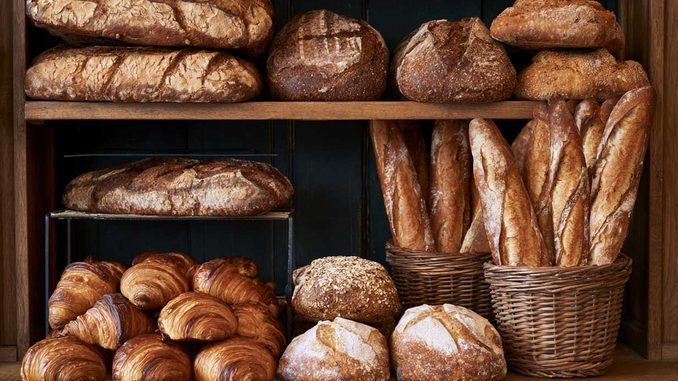
Discover how flour types, gluten and yeast shape French bread, explore world-famous artisan bakers and learn to make an authentic traditional baguette.
The quality of bread depends on three essential factors: flour composition, fermentation and the baker’s technique. In France, wheat flour is classified from T45 to T150 according to its mineral content. T55 is widely used for white bread, while T65 is particularly suited to traditional French baguettes. Higher classifications, including T80, T110 and T150, produce bread with more whole-grain character.
Fermentation is equally important. Commercial baker’s yeast provides predictable rising, while natural sourdough develops more complex aromas through the combined activity of yeasts and lactic acid bacteria.
France’s leading bakers, including Éric Kayser, Apollonia Poilâne and Frédéric Lalos, have demonstrated how flour selection and fermentation can transform a simple product.
Making an authentic baguette requires flour, water, salt and yeast or sourdough. France’s 1993 bread decree protects the designation pain de tradition française, while UNESCO recognised the craftsmanship and culture of baguette-making in 2022.
The different types of flour determine a bread’s texture and flavour
Flour is the structural foundation of bread. Its protein composition, mineral content, milling process and ability to absorb water influence almost every stage of production.
In France, wheat flour is classified according to its ash content, the mineral residue remaining after a flour sample is incinerated.
The higher the classification number, the greater the mineral content and, generally, the proportion of the grain’s outer layers retained during milling.
The French flour classification from T45 to T150
T45 contains less than 0.50% mineral residue. Highly refined, it is mainly used for cakes, pastries and certain viennoiseries.
T55 contains between 0.50% and 0.60%. It is a standard white flour suitable for everyday bread, pizza dough and some baguettes.
T65 flour, with 0.62% to 0.75% mineral content, is particularly associated with pain de tradition française. It offers a balance between a light crumb, flavour development and bread-making performance.
T80, containing 0.75% to 0.90% minerals, is known as farine bise. It produces more characterful country loaves and semi-wholemeal sourdough bread.
T110 contains 1.00% to 1.20% minerals and retains more of the wheat’s outer layers. It is used for wholemeal-style breads.
T150, with more than 1.40%, is integral wheat flour. It produces darker, more substantial bread with a higher fibre content.
These classifications describe mineral composition, not flour strength.
The gluten network determines whether bread rises properly
When wheat flour absorbs water, two proteins, glutenin and gliadin, combine to form gluten.
Gluten gives dough its elasticity and extensibility. It traps the carbon dioxide released during fermentation, allowing bread to expand.
Protein content is therefore important. King Arthur Baking, for example, specifies 11.7% protein for its all-purpose flour and 12.7% for its bread flour.
French millers also measure dough strength using the Chopin alveograph, which expresses baking strength through a W value.
A stronger flour generally tolerates more demanding fermentation and hydration conditions.
However, excessive strength can make a baguette difficult to stretch and shape.
The different grains produce traditional and unconventional breads
Wheat is not the only cereal used in artisan baking.
Rye flour contains gluten-forming proteins but cannot build the same elastic network as wheat. Its pentosans, which absorb considerable water, contribute to the dense, moist texture of German rye bread.
Spelt flour contains gluten and produces bread with a distinctive, often nutty flavour. Its dough can be more delicate to handle than conventional bread wheat.
Buckwheat is naturally gluten-free. It is used in Breton galettes and can be blended into speciality breads, although substantial additions require structural adjustments.
Teff, another gluten-free grain, is traditionally fermented to produce Ethiopian injera, a soft, porous flatbread.
Whole wheat flour is central to Indian chapati, while Italian focaccia relies on wheat dough, generous hydration and olive oil.
These examples illustrate the diversity of French food and regional culinary traditions and how different grains influence national baking cultures.
The choice between yeast and sourdough changes the fermentation process
Bread fermentation converts available sugars into carbon dioxide and other compounds that influence flavour.
The commercial yeast provides controlled fermentation
Most commercial baker’s yeast consists of Saccharomyces cerevisiae.
It is sold in three principal forms.
Fresh compressed yeast contains living yeast cells in a moist block and must be refrigerated.
Active dry yeast contains dehydrated cells and is often rehydrated before mixing, depending on the manufacturer’s instructions.
Instant dry yeast is more finely processed and can generally be mixed directly with flour.
As a practical conversion, 3 g of fresh yeast corresponds to approximately 1 g of instant yeast.
Commercial yeast provides relatively predictable fermentation, making it suitable for baguettes, sandwich bread, brioche and many other preparations.
Baking powder is different. It produces gas through chemical reactions and is not a biological fermentation agent.
The natural sourdough develops more complex aromas
Natural sourdough, or levain, consists of flour and water colonised by yeasts and lactic acid bacteria.
The yeasts produce carbon dioxide. The bacteria generate organic acids that modify flavour, acidity and keeping quality.
A sourdough culture must be maintained through regular refreshments with flour and water.
Fermentation generally takes longer than with commercial yeast, although the duration depends on the culture’s activity, temperature and recipe.
Sourdough is particularly suitable for country loaves, whole-grain bread and traditional rye preparations.
It does not automatically produce healthier bread, nor does it make wheat bread safe for people with coeliac disease.
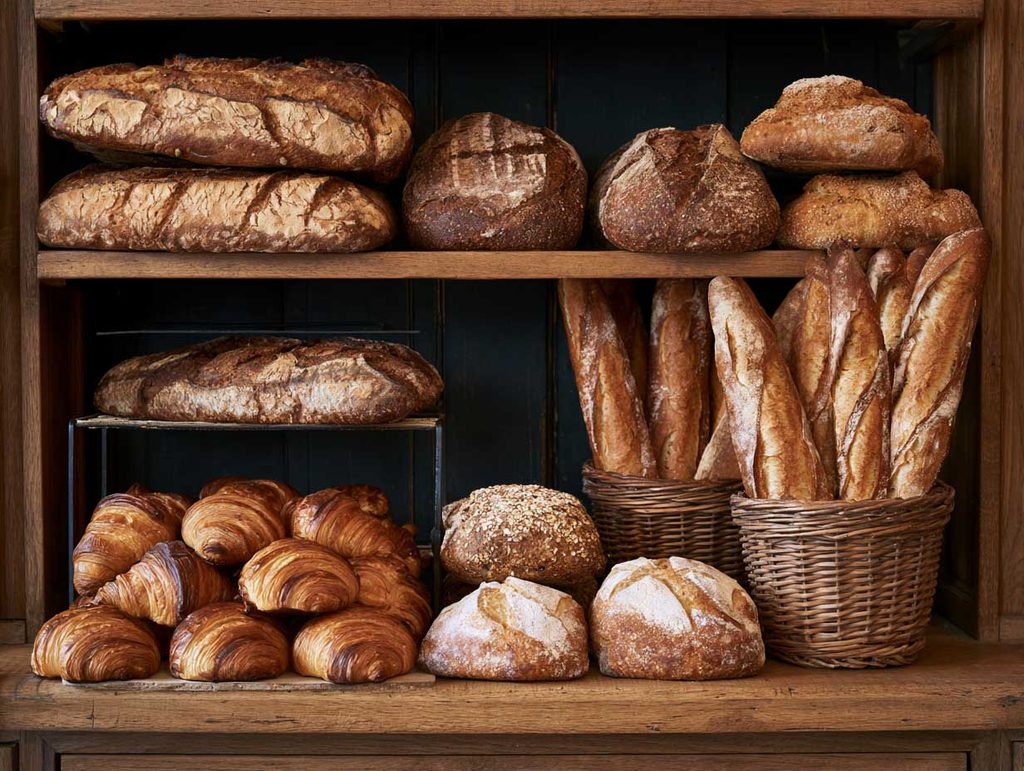
The world’s leading artisan bakers have transformed bread-making
France remains an international reference for artisan bread.
Éric Kayser opened his first Maison Kayser bakery in Paris in 1996. He became known for developing traditional bread using natural levain and carefully selected flours.
Apollonia Poilâne continues the family bakery founded in 1932. Its signature miche Poilâne, weighing approximately 1.9 kg, uses stone-ground wheat flour, water, Guérande salt and natural sourdough. It is baked in wood-fired ovens.
Frédéric Lalos, awarded Meilleur Ouvrier de France in baking in 1997, is recognised for artisan production and breads supplied to prestigious restaurants.
Internationally, Chad Robertson, co-founder of Tartine in San Francisco, helped popularise long-fermented, high-hydration sourdough bread.
British baker Richard Hart, formerly head baker at Tartine, co-founded Hart Bageri in Copenhagen in 2018.
French-born Richard Bertinet, based in the United Kingdom, is also influential for his bread-making books and techniques for handling wet dough.
Their methods differ, but all emphasise fermentation, flour quality and skilled dough handling.
The authentic French baguette follows a precise legal definition
France’s decree of September 13, 1993, established the conditions for using the designation pain de tradition française.
The dough must principally contain bread-making wheat flour, drinking water and salt, with baker’s yeast, sourdough or both.
It must contain no additives and cannot undergo deep-freezing during production.
The decree permits limited quantities of specific flours: up to 2% broad bean flour, 0.5% soy flour and 0.3% wheat malt flour.
The law does not prescribe a single fermentation duration, baguette length or compulsory use of sourdough.
The French baking federation notes that baguette weights vary regionally, although approximately 250 g is customary around Paris.
The national traditional baguette competition imposes stricter specifications, including a length of 50 cm, with a tolerance of 2 cm.
The distinction matters: a genuine French traditional baguette is defined by ingredients and production conditions, not simply its elongated shape.
The traditional French baguette recipe requires patience and precision
A good homemade baguette needs little equipment beyond a scale, baking tray or stone, sharp blade and oven capable of generating steam.
The ingredients for three small baguettes
For a dough weighing approximately 857 g, use:
- 500 g French T65 wheat flour, without additives
- 345 g water
- 10 g fine salt
- 2 g instant dry baker’s yeast, or approximately 6 g fresh yeast
The formula provides 69% hydration and 2% salt relative to flour weight.
For a long overnight fermentation, reduce the instant yeast to approximately 1 g, or use 3 g fresh yeast.
The mixing and fermentation develop the dough structure
Combine the flour with 325 g of water and leave to rest for 20–30 minutes.
Add the yeast, salt and remaining water. Mix until the dough becomes cohesive and elastic.
Allow it to ferment for approximately 90 minutes at 22–24°C, folding it twice to strengthen the gluten.
Refrigerate the dough for 10–14 hours at approximately 4°C to develop additional flavour.
The following day, divide it into three equal pieces. Shape each gently into a short cylinder and allow 15–20 minutes of rest.
Roll each piece into an elongated baguette, approximately 35–40 cm long for a domestic oven.
Leave the shaped dough to proof for 45–90 minutes, depending on its temperature and activity.
The oven temperature and steam determine the crust
Preheat the oven to 250°C (482°F), preferably with a baking stone or steel.
Make three to five overlapping diagonal cuts along each baguette using a sharp blade.
Transfer the dough to the hot baking surface and introduce steam using a preheated metal tray and carefully added hot water.
Bake for approximately 10 minutes at 250°C, then release the steam, reduce the temperature to 230°C (446°F) and continue for another 12–15 minutes.
The crust should become deeply golden, crisp and well developed.
Allow the baguettes to cool on a rack before cutting.
The finished bread should have an irregular, cream-coloured crumb and a crust that cracks under gentle pressure.
Home bakers seeking direct instruction can explore an artisan bread and croissant workshop in Paris or a bread-making workshop at École Ducasse Paris Studio.
The quality of bread ultimately depends on time and technique
Premium flour alone cannot guarantee good bread. Nor can an expensive oven compensate for inadequate fermentation or poor shaping.
The essential skill lies in understanding how flour, water, temperature and microorganisms interact.
A baker must recognise when a dough has developed sufficient strength, when fermentation is complete and when the bread is ready for the oven.
That combination of knowledge and judgement explains why UNESCO recognised the artisanal know-how and culture of the baguette in 2022.
A baguette made with four simple ingredients remains one of the clearest demonstrations of the difference between merely producing bread and mastering the craft of baking.