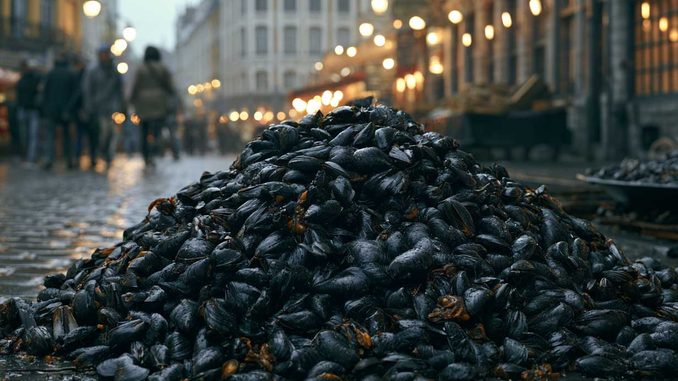
On 5–6 September 2026, Europe’s largest flea market returns to Lille, where 500 tonnes of mussels turn bargain hunting into a vast food festival.
On 5 and 6 September 2026, Lille will once again surrender its city centre to the Braderie de Lille, Europe’s largest flea market and one of France’s most extraordinary popular gatherings. The official event runs for 34 continuous hours, from 8 a.m. on Saturday to 6 p.m. on Sunday. Recent city figures put attendance at around 2.5 million visitors, with more than 5,200 exhibitors and roughly 51 km of stalls. Yet the Braderie is as much about eating as bargaining. Around 500 tonnes of mussels and 30 tonnes of fries were consumed during the 2025 edition. Restaurants build the famous piles of empty shells that have become part scoreboard, part street theatre and part Lille iconography. Alongside moules-frites come regional beers, waffles, carbonnade flamande and other northern specialities. What began as a medieval trading fair has become a remarkable combination of commerce, food culture and collective ritual.
The Braderie turns an entire city into a market
The Braderie de Lille 2026 begins at 8 a.m. on Saturday, 5 September, and closes at 6 p.m. on Sunday, 6 September. That makes 34 hours of almost uninterrupted trading, eating and street activity.
Calling it a flea market hardly captures its scale.
Current figures published by the City of Lille cite around 2.5 million visitors, more than 5,200 exhibitors in 2025 and approximately 51 km of stalls. Professional antique dealers, residents, associations and local shops occupy large sections of central Lille and Vieux-Lille.
The event has medieval roots. Historical records refer to a major fair in Lille by the 15th century, although the city traces the broader tradition further back. Foreign merchants once came to sell goods tax-free. Later, servants were allowed to sell unwanted possessions belonging to their employers. By the 19th century, second-hand trading had become central to the event.
That history explains why the Braderie still feels different from a conventional commercial festival. Selling used objects is not a themed attraction added for visitors. It is the institution’s original economic function.
Food developed alongside it.
The moules-frites tradition has become an event within the event
Nothing represents the modern Braderie more effectively than moules-frites.
According to Lille’s official figures, around 500 tonnes of mussels and 30 tonnes of fries were consumed during the 2025 event. Even allowing for the imprecision inevitable in estimates made across hundreds of restaurants and temporary food operations, the scale is exceptional.
Spread mathematically across the Braderie’s 34 hours, 500 tonnes would represent almost 15 tonnes of mussels per hour.
The dish also makes operational sense for a mass event. Mussels can be cooked rapidly in large batches. The City of Lille describes a cooking time of roughly five to ten minutes, depending on quantity and method. Fries can likewise be produced continuously. Together they create a hot meal that is relatively simple to serve quickly to large numbers of customers.
The classic preparation is moules marinières, usually cooked with white wine, shallots or onions and herbs. But Lille restaurants increasingly offer alternatives using cream, garlic, curry or the region’s strongly flavoured Maroilles cheese. For the 2026 Braderie, for example, the Bistrot de St So has announced marinière, Maroilles and Thai-style versions.
The pairing itself has a less tidy history than popular legend suggests. Lille’s municipal history notes that mussels may have been sold at the Braderie as early as the 15th century, while the association between mussels and fries became firmly established much later. The dish was popularised in northern France and Belgium during the 19th century.
That uncertainty does not weaken the tradition. It makes it more credible. Popular food customs rarely begin on a precise date.
The shell piles turn dinner into a public scoreboard
The most distinctive feature comes after the meal.
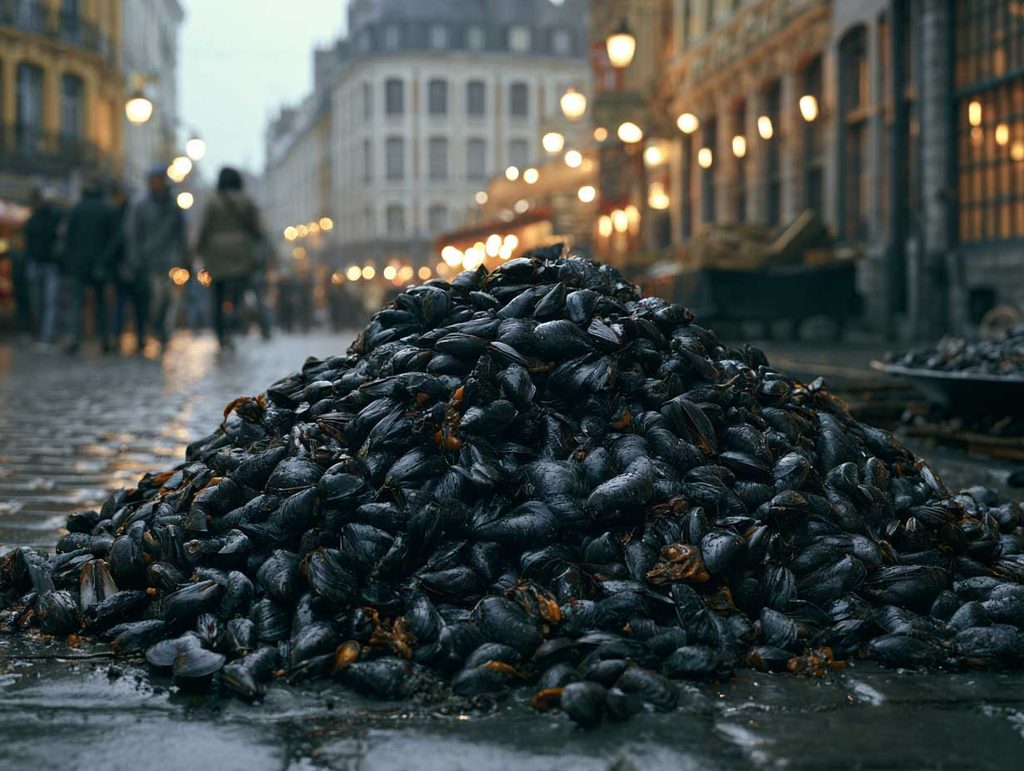
Restaurants traditionally stack their empty mussel shells outside, creating enormous black shell piles that grow throughout the weekend. In 2025, the city recorded 15 such piles within the Braderie perimeter.
They serve no culinary purpose. Their function is cultural and visual.
A large heap tells passers-by that a restaurant has been busy. It transforms consumption into a public spectacle and provides one of the Braderie’s most recognisable images.
The shells have also created a waste-management challenge. Lille says that around four tonnes of shells were separately collected in 2025 and recycled into tiling material. That figure should not be confused with the 500 tonnes of mussels consumed: only a fraction of the resulting shells enter this dedicated recycling stream.
The city has experimented further. Shells from the 2024 Braderie were incorporated into material used to make ten public benches, installed outside Lille’s Hôtel de Ville in 2025.
A tradition once designed to display excess is therefore slowly becoming an experiment in circular materials.
The regional cuisine extends far beyond mussels
Moules-frites dominate the weekend, but they sit within a much broader northern French and Flemish food culture.
The carbonnade flamande is one of its clearest examples. Beef is slowly braised in dark beer, usually with mustard and a sweet component such as gingerbread, producing a dense sweet-and-savoury sauce. It is typically served with fries.
Welsh, another Lille staple despite its British origins, combines bread, cheddar, beer, mustard and often ham, sometimes finished with an egg. Potjevleesch offers a very different tradition: several white meats cooked and served in jelly, usually with fries.
Beer is equally central. Lille lies within one of France’s strongest brewing regions, and local and regional beers naturally accompany the heavier Flemish dishes.
Dessert has its own emblem. The Lille waffle differs from the thick Brussels waffle. It is thin, soft and traditionally filled with vergeoise, a brown sugar derived from beet. Maison Méert, established in Lille in 1761, made the filled waffle one of the city’s best-known culinary signatures.
The significance of this wider menu is easy to overlook. The Braderie does not merely attract people who then need feeding. Food is part of the reason people come.
The gastronomy reveals what makes the Braderie endure
Large public events increasingly struggle to distinguish themselves. Flea markets exist everywhere. Food festivals do too.
Lille combines the two at a scale few cities could reproduce.
The second-hand stalls provide the hunt. The historic centre supplies the setting. Beer, waffles and Flemish dishes establish the regional identity. Moules-frites provide the ritual that almost every visitor recognises.
That combination explains why the mountains of black shells matter more than their appearance might suggest. They are not simply restaurant waste. They are a visible record of collective participation.
For one weekend each September, Lille does something increasingly rare in European cities: it allows commerce, food, history and disorder to occupy the same streets on an immense scale.
The bargain may bring visitors to the stall. The moules-frites make the weekend memorable.
Cook in France is your independant source for food in France.